Thứ Hai, 26 tháng 10, 2015

Warm-hearted, welcoming and traditional, but never out of touch with the outside world, the people of Hoi An, VietNam are in overdrive mode trying to catch up to the opportunities their new found fame has recently given them.

A History of Asian fusion
A slow stroll through town reveals its gems. Hoi An has to this days well preserved its most sacred treasure, the centuries-old architecture. The town used to harbor foreign traders back in the 17-18th, and once is an important heavily-frequented trading port in Southeast Asia. The foreigners come from all corners of the world, but mostly are Chinese and Japanese nationalities. Some come and go, but many settle in permanently and etch their marks into the history of Hoi An.

>>> Other: the temple of literature is a Temple of Confucius in Hanoi, northern Vietnam


Chùa Cầu - A popular attraction in Hoi An
Mixing together with Vietnamese design, Chinese and Japanese accents melt and create a picture-perfect Hoi An of the late 19th century, which it has somehow remained mostly intact since. The end product is an oddly strange-yet-familiar sight that exists nowhere else in the world. To this day, few descendants of the foreign traders remain but the architectural setting manages to survive the damage of time.
>>> Other: vietnam travel 630875 likes · 5988 talking about this. We are willing to provide you a board image of Vietnam's culture, people, city


Little town gathers world fame
In 1999, UNESCO formally recognizes Hoi An as a World Heritage Site. There are the things that make up the reputation. Hoi An is home to many temples, pagodas and the ancient homes that bear its very unique mark. The density of such sites is unlike any other in Vietnam. These places carry with them the history of Hoi An itself. The depiction of its formation, its once-prosperous merchant past, its progress and how it manages to become one of today are all well documented, in words and in priceless relics.
   
Hoi An earned UNESCO recognition since as early as 1999
The town is not just reminiscent of the past, it truly takes one for a slow enlightening journey to the past. Such journey is simply unthinkable most elsewhere in Vietnam. It is only possible because of the careful and dedicated works that have gone into preserving and presenting its way - efforts that have come as the result of the UNESCO recognition. Enjoying the spotlight and catering to the increasing number of tourists flooding its narrow streets hoping to catch a glimpse of the past, hotels and resorts are now sprouting up all over town.
Hoi An Accommodation and Shopping
One shall find his accommodation options ranging from lowly affordable motel rooms as low as $8 per day to the world-class 6-star top-of-the-line allegedly-best-in Southeast-Asia Nam Hai resort nearby, which starts at a whooping $600. Vietnam may be small, but there will always be an extra bedroom for the staying- over guest. These days, the guests may well outnumber the homeowners however. True to its origin, Hoi An today still boasts a booming trade.
          
Nam Hai Resort amongst the most luxury in the world's hotel industry
Of the things sold in town, there are only 3 different categories. First is souvenir, the second being clothing and the last is food, both western and Vietnamese. The souvenir is not something to write home about, since offerings are limited in diversity throughout the country. Hoi An is better known for its tailor shops, which mostly service personal bespoke orders. Tourists circulate rumor that people stay in this little sleepy town for entire weeks doing nothing, waiting just to have their shirts made to the perfect fit. Most designs are traditional Vietnamese in nature, with some offer contemporary twists and touches of foreign taste as well.
           
Hoi An lantern makes a perfect house deco - and inexpensive
Coupled with the right prices, Hoi An is truly a shoppers’ paradise, one that dictates its western customers on a unique oriental sense of style. Paradox does not end. One imagines never being able to find western food in such a hardcore Vietnamese setting. That turns out not the case. Hoi An is home to multiple restaurants that serve big hearty American meals with only a small portion of the menu dedicated to local food. The locals prefer their sidewalk vendors to the many re-innovated house-turned-restaurants out there.
Of Food and Cuisines
There is no shortage of bacon in town, but cao lầu is the dish that one simply can not miss. Prices and service are rightfully on par with the latest venues in major cities like Hanoi and Ho Chi Minh. Yet in the face of all the hurrying capitalist business going on, for some reason, somehow, Hoi An retains its quite serenity. Life just seems to flow by at an uneventful rate. People seem to slowly enjoy things as they are. While foreigners come to experience the old way, natives also come to Hoi An for a break in the hustling busy path of life.
         Hoi An Chicken Rice         
Hoi An Chicken Rice - A must try of Hoi An
And it is in Hoi An that their inner peace shall be found, paradoxically in the face of all the money being changed hand. As for a fitting end to a story of many extremes, Hoi An is, sadly, situated in one of the poorest provinces in the country. Apart from the glamour of the tourism-enriching little town, Quang Nam’s population generally lives at the poverty line level. A typical drive from Danang’s airport or train station to Hoi An soon enough will reveal all the stories that are silently told.
Nestled along wooded boulevards among the city’s two dozen lakes you will find architectural souvenirs left by all who conquered this great valley, from the Chinese who first came in the last millennium to the French, booted out in our own century.
>>> More: the temple of literature vietnam as the first university of Vietnam.


Getting into Hanoi, Vietnam

The trip into the city from Noi Bai Airport takes about an hour and offers some poignant glimpses of modern Vietnamese life: farmers tending their fields, great rivers, modern highways that abruptly become bumpy roads. The drive is especially breathtaking at dusk when the roads fill with bicycles, and everything takes on the same deep colors as the modern paintings you see in Hanoi's galleries. Somehow the setting sun seems enormous here as it dips into the cornfields on the horizon.

On the edge of the city the road dissolves into a maze of winding, narrow, wooded lanes. You are surrounded by roadside artisans, shops and taverns, then by graceful villas and commuters on bicycles, cyclos and motorbikes. Modern buildings appear from nowhere, looking so out of place that you have to wonder if they were dropped from the sky and just left where they came to rest. While you tell yourself that nothing as preposterous as Hanoi can be so beautiful, you cannot help but be dazzled.
>>> More: hanoi opera house schedule  of shows for Octorber! Let to enjoy liveshow

Getting Around

Meter taxis and hired cars are easy to find in Hanoi. If you plan an extended visit you might consider renting a bicycle or motorbike.
Street Vendors are omni present in Hanoi
The north end of Hoan Kiem Lake is Hanoi's "ground zero." Practically all the city’s economical hotels, tourist shops, and cafés catering to visitors are located here. Not only is it the oldest part of the city, it is the busiest and most interesting. Every street is winding, intimate, and shady. At night the lights of storefronts keep the streets lit and animated.

Depending on which guide book you read, this district of Hanoi is variously called the "Old Quarter," the "Ancient Quarter," and "36 streets." It is wedged between the northern shore of Hoan Kiem Lake, the walls of the ancient Citadel, and the levies that protect the city from the Red River. The 36 little streets in the quarter are each named for a commodity once sold by all the businesses on that street. Streets here are named for the medicine, jewelry, fans, copper, horse hair, chicken, and even coffins once sold on them. This explains why the names of some of the longer streets inexplicably change after one or two blocks. As you explore, you will still happen upon entire blocks of tinsmiths, tailors, paper goods merchants, and lacquerware makers.

In the Ancient Quarter the most appealing mode of transportation for those who do not care to enjoy the "36 Streets" on foot is the cyclo. Often they are driven by men wearing pea-green pith helmets that make them look like soldiers. Settle on the fare in advance (a dollar or less one way). Most drivers will also quote you an hourly rate and will take you to all the obligatory cultural and historical spots.

Thứ Tư, 14 tháng 10, 2015

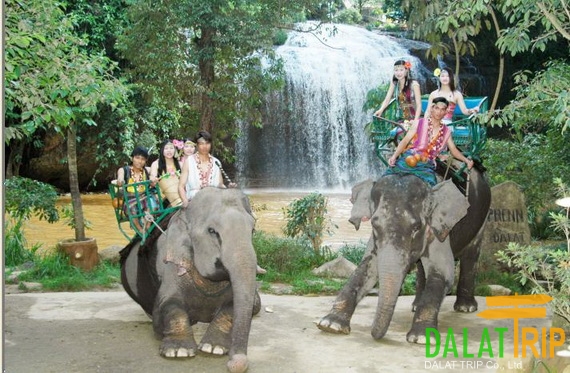
Prenn waterfall is located at the foot of Prenn Pass which is 10 km far from Dalat city, Vietnam. Prenn waterfall is the gateway of Dalat. In the old time, there was a village of Prenn up the stream, so the waterfall bears the name Prenn.

Overview of Prenn Waterfall in Dalat

It has the height of 9m, and the width of 20m and it lies on the stream of Prenn. From its height, the water flows down over a cliff of basalt rock creating a white curtain of water like the hair of a fairy.
Prenn waterfall
Prenn waterfall
Around 1960, at Prenn waterfall, there was a small zoo including elephant, tiger, bear, deer, monkey, python, peafowl, etc.

Area of tourist site in Prenn falls

At present, the tourist site has an area of 160 ha, of which the pine forest and primitive trees make up 90% of the area. The site has been restored and equipped with the cable – car, suspension bridge, stilt – house, huts on the trees, showroom of silk painting, souvenir shop and the services like folklore music performance, rowing – boat, folklore game, ect and a restaurant serving food as the desires of tourist, especially the snake-head fish soup.

Activities at Prenn waterfall

Many interesting activities including elephant and ostrich rides. The humble elephant will take you through unspoiled nature such as small creeks, lakes and green forests. For those who really want to try something different, here is your chance. Ostriches might not be a common transport option but here in Dalat you can ride on one. The idea of climbing up on an ostrich’s back can be quite a challenge but once you manage to get up there and start the ride it is one of the most interesting experiences as these well-trained animals are used to human and are amazingly friendly.
Ostriches Ride at Prenn

In the East of Prenn waterfall, we can see a complex of Au Lac Temples, which is located on a hillside, worshipping Hung Kings. This is a new model of tourism; for both eco-tourism and for remembering the ancestors. The temples were designed like the original temple in Phu Tho(including the lower (Ha) temple, the middle(Trung) temple and the upper(Thuong) temple and were launched on 10 March, 2004.
From the waterfall, tourist can climb to the temples through steps or they can hire a jeep to the lower temple then they can go on foot to the middle temple which worship the god of rice and then to the upper temple. Soil, water and the joss-stick burner were taken from the original Hung temple. 100 pieces of round rocks(taken from Ninh Thuan) symbolize for 100 eggs and they all put beside the statues of Lac Long Quan – Au Co.
Nearby the upper temple, we can see the pearl well(or Gieng Ngoc0 with clear water and big Gong-shaped rock with the sound like a bell. Standing from the upper temple, tourist can see the view of elephant mountain in the far distance and the magnific landscapes of the outskirts of Dalat. Visitor can go step by step to arrive Au Lac park.
On 10 of March (lunar month) yearly, people often hold the Death anniversary of Hung King and other activities like folklore song of Bac Ninh, Thai dancing, Kho gong performance, etc.
In 1998, Prenn waterfall was recognized as a Cultural historical heritage.
 Other topics:  Come to Hanoi to see temple of literature vietnam and hanoi opera house schedule. You can descovery interest many thing